Batteries are one of the most important parts of electrochemical energy storage systems. With the reduction of battery costs and the improvement of battery energy density, safety and life, energy storage has also ushered in large-scale applications. This article will introduce several important parameters of energy storage batteries.
01
Battery capacity
Battery capacity is one of the important performance indicators for measuring battery performance. The capacity of a battery is divided into rated capacity and actual capacity. The amount of electricity discharged by the battery under certain conditions (discharge rate, temperature, termination voltage, etc.) is called rated capacity (or nominal capacity). Common units of capacity are mAh, Ah=1000mAh. Taking a 48V, 50Ah battery as an example, the battery capacity is 48V×50Ah=2400Wh, which is 2.4 kWh.
02
Battery discharge C rate
C is used to indicate the battery charge and discharge capacity rate. Charge and discharge rate = charge and discharge current/rated capacity. For example, when a battery with a rated capacity of 100Ah is discharged at 50A, its discharge rate is 0.5C. 1C, 2C, and 0.5C are battery discharge rates, which are a measure of how fast or slow the discharge is. If the capacity is fully discharged in 1 hour, it is called 1C discharge; if it is fully discharged in 2 hours, it is called 1/2=0.5C discharge. Generally, the capacity of the battery can be detected by different discharge currents. For a 24Ah battery, the 1C discharge current is 24A, and the 0.5C discharge current is 12A. The larger the discharge current, the shorter the discharge time.
Usually when talking about the scale of an energy storage system, the maximum power of the system/system capacity is used to express it (KW/KWh). For example, the scale of an energy storage power station is 500KW/1MWh, where 500KW refers to the maximum charge and discharge power of the energy storage system, and 1MWh refers to the system capacity of the power station. If the discharge is carried out at a rated power of 500KW, the capacity of the power station is fully discharged in 2 hours, and the discharge rate is 0.5C.
03
SOC (State of charge) State of charge
The English name of battery state of charge is State of Charge, or SOC for short. It refers to the ratio of the remaining capacity of a battery after it has been used for a period of time or has been left unused for a long time to the capacity of its fully charged state. It is usually expressed as a percentage, which simply means the remaining power of the battery.
04
DOD (Depth of Discharge) Depth of discharge
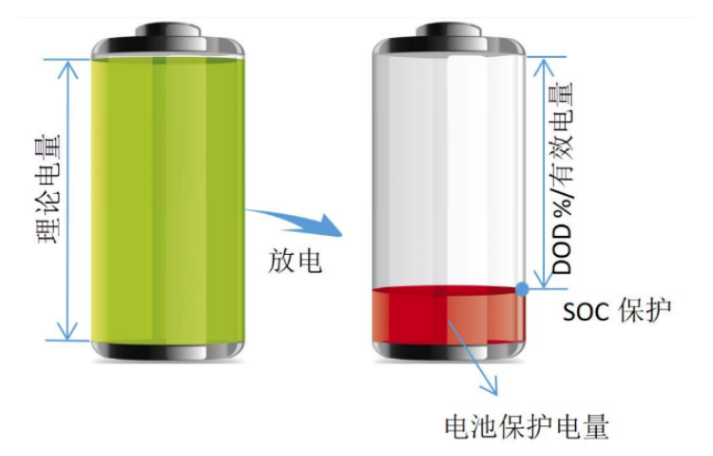
Depth of discharge (DOD for short) is used to measure the percentage between the discharge amount of a battery and the rated capacity of the battery. For the same battery, the set DOD depth is inversely proportional to the battery cycle life. The deeper the discharge depth, the shorter the battery cycle life. Therefore, it is important to balance the required operating time of the battery and the need to extend the battery cycle life.
If the change in SOC from completely empty to fully charged is recorded as 0~100%, in practical applications, it is best to let each battery work in the range of 10%~90%. If it is lower than 10%, it may be over-discharged, resulting in some irreversible chemical reactions that affect the battery life.
05
SOH (State of Health) Battery Health Status
SOH (State of Health) indicates the current battery's ability to store electrical energy relative to a new battery, and refers to the ratio of the current battery's fully charged energy to the fully charged energy of a new battery. The current definition of SOH is mainly reflected in several aspects such as capacity, power, internal resistance, number of cycles, and peak power, with energy and capacity being the most widely used.
Generally, when the battery capacity (SOH) drops to around 70% to 80%, it can be considered to have reached EOL (battery end of life). SOH is an indicator that describes the current health status of the battery, while EOL means that the battery has reached the end of its life and needs to be replaced. By monitoring the SOH value, the time when the battery reaches EOL can be predicted, and corresponding maintenance and management can be performed.


 Lead-Acid to Lithium: Calculating Your TRUE Return on Investment.
 Why Did My E-Bike “Suddenly Die”? Understanding BMS Protection.
 Sudden Power Drop When Accelerating? It’s Not Your Battery’s Fault
 日本語
日本語  Español